



By: Xihe-
On: 10 Jun 2026


| Sub-Total : | $23.30 |
| Eco Tax (-2.00) : | $4.52 |
| VAT (20%) : | $5.66 |
| Total : | $33.48 |
By: Xihe-
On: 10 Jun 2026
On the morning of June 3, 2026, the 16th Songshan Lake China IC Innovation Summit was held at the Hyatt Regency Songshan Lake in Dongguan. Focusing on “China’s IC Innovation” and empowering “AI glasses,” the forum showcased a range of new domestic IC products designed for the industrialization of AI glasses, covering key areas such as main control SoCs, micro-displays, wireless connectivity, smart sensing, audio amplifiers, and power management.
Unlike previous years, when domestic chips were primarily focused on substitution, supply chain supplementation, and isolated breakthroughs, the signals sent by this forum are much clearer: AI glasses are moving from proof-of-concept to the deep waters of industrialization, and the core challenge facing chip companies has shifted from “whether it can be done” to “whether a system-level balance can be found between slim design, low power consumption, long battery life, mass-producibility, and an affordable price.”
By 2026, AI glasses are evolving from simple visual aids into the next-generation mobile smart devices and personal gateways for AI agents. Against this backdrop, this year’s forum invited ten domestic IC companies to showcase their products, covering the entire supply chain from main control SoCs to display, connectivity, sensing, audio, and power management. In other words, AI glasses are no longer merely a matter of product definition for device brands, but rather a chip-level redesign centered on edge computing power, sensory interaction, battery life management, and wearability.
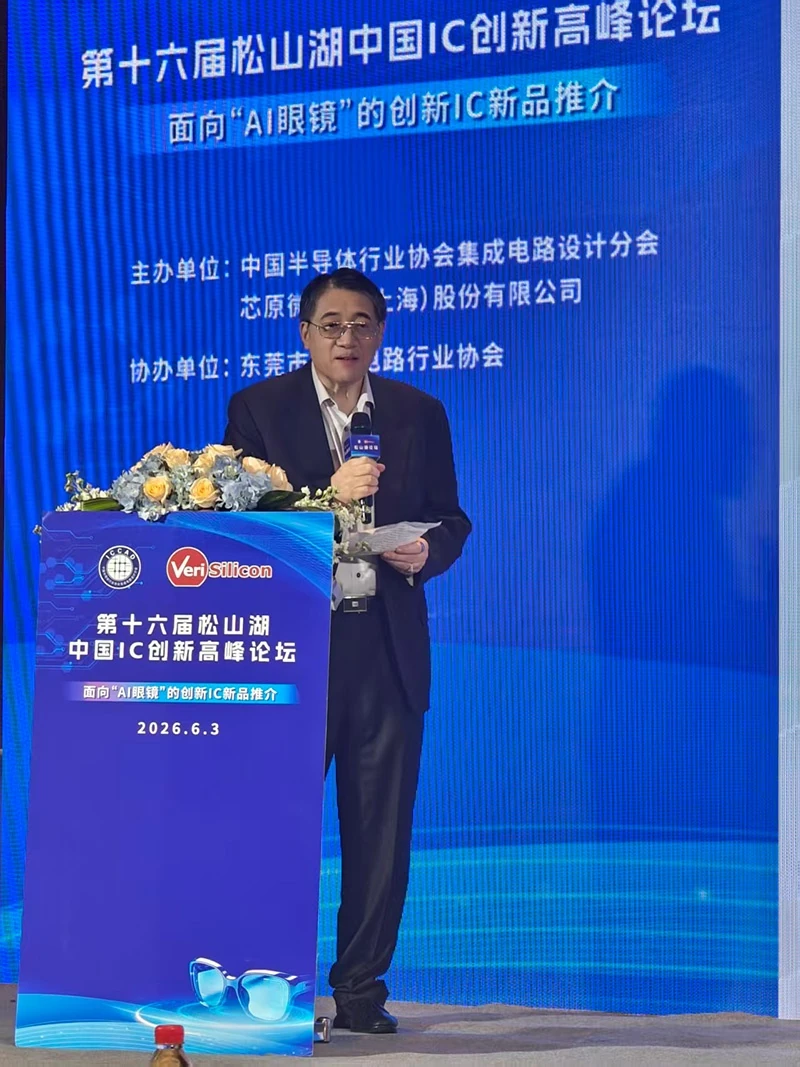
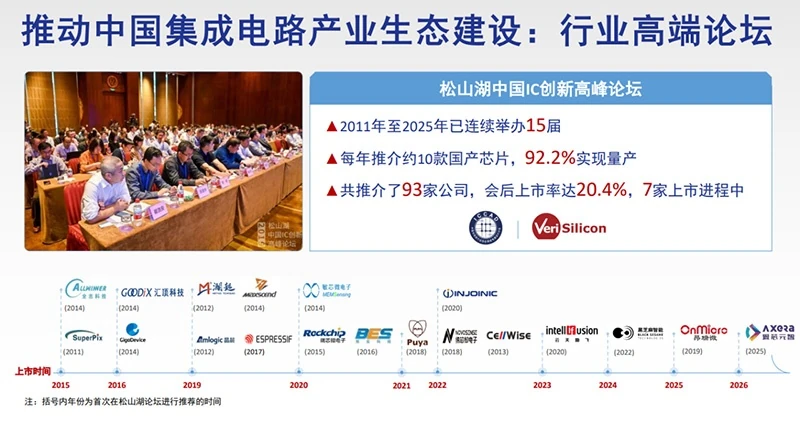
This “practical focus” is also reflected in the choice of this year’s forum theme. Over the past year, embodied intelligent robots have been a hot topic in the industry, and the 15th forum centered on “Introducing Innovative New IC Products for Embodied Intelligent Robots.” This year, however, the forum has returned its focus to AI glasses. Dai Weimin noted at the event that AI glasses have now entered a critical phase, and the industry must address two key questions: What kind of glasses can achieve shipments in the millions, and what role should chips play in this context?
This is also the most critical challenge currently facing the AI glasses industry. On the one hand, AI glasses are viewed as the most natural personal gateway for AI agents, offering inherent advantages such as being worn, listened to, viewed, and sensed constantly; on the other hand, glasses are a product form that is extremely sensitive to power consumption, weight, size, heat dissipation, and price. Users will not accept AI glasses that require frequent removal for charging, are heavy to wear, or are excessively expensive. For chip manufacturers, this means that simply piling on computing power is not a viable solution; low power consumption, high integration, small packaging, and system synergy will be the key factors determining whether a product can be mass-produced.
Judging from the products showcased at this event, domestic IC manufacturers are collaborating to overcome the key bottlenecks in AI glasses. During the morning session, Hefei CoolChip Microelectronics Co., Ltd. introduced the ARS45, a highly integrated, low-power SoC designed for AI glasses; Guangzhou Ankai Microelectronics Co., Ltd. showcased the “Kongming 4th Generation” SoC for AI camera glasses; and Shanghai Awei Electronics Technology Co., Ltd. demonstrated the AWA88188, a flagship AI glasses power amplifier featuring low power consumption, a compact package, and on-device computing capabilities.
In the display and connectivity segment, Nanjing Xinshiyuan Electronics Co., Ltd. showcased its 0.13-inch LCoS silicon-based microdisplay chip, the “Tianmu 80”; Chongqing Wuji Microelectronics Co., Ltd. introduced the ultra-low-power dual-band Wi-Fi 6 chip WQ9002, aiming to address the balance between wireless connectivity and battery life in AI glasses; while SmartSens showcased the 12-megapixel CMOS image sensor SC1220IOT designed for AI glasses.
The afternoon agenda continued to cover high-speed interfaces, sensing, power management, and timing infrastructure. Silicon Valley Analog introduced the ANX7443, a USB-C/DP high-speed SerDes repeater; KunTai Microelectronics presented the KTM1305, emphasizing ultra-low power consumption and ultra-high sensitivity to address sensing bottlenecks in smart glasses; Saiwei Microelectronics showcased the CW1312, a single-cell lithium battery protection chip designed for AI glasses; Dagong Communications showcased its MEMS-TCXO products, aiming to support smart interactive experiences with a high-precision timing foundation.
These products collectively point toward breaking down AI glasses from a “terminal concept” into a series of engineering problems that chip companies can address one by one: The main control chip must balance performance and power consumption; the display chip must balance brightness, size, and cost; the connectivity chip must reduce power consumption caused by constant connectivity; sensors must balance accuracy, sensitivity, and low power consumption; while audio and power management chips directly impact users’ perception of battery life, interaction, and wearing comfort.
From an industry perspective, the reason AI glasses are once again becoming a focal point for chip companies in 2026 is that they sit at the intersection of multiple trends. First, large language models and AI agents require new personal entry points; while smartphones remain the core devices, glasses offer superior on-the-go sensing capabilities. Second, edge AI is shifting from merely “running models” to “continuous operation,” placing higher demands on chip power consumption and system scheduling. Third, AI glasses have a natural connection to scenarios such as XR, audio, photography, translation, navigation, and office assistance, and the device form factor is expected to evolve from a niche product for tech enthusiasts to a broader consumer electronics market.
However, the challenges are equally clear. There is still no unified product definition for AI glasses. Whether they should be audio-focused, camera-focused, display-equipped, or spatial computing devices closer to AR glasses remains a matter of experimentation among different manufacturers. Decisions regarding whether to include a display, whether to add a camera, how long the battery life should be, and whether the price can be kept within the mass-market range will directly determine the product roadmap and, in turn, influence the technical choices made by the chip supply chain.
Therefore, the significance of this forum lies not merely in “showcasing ten chips,” but in refocusing the industrialization of AI glasses back to the chip and system engineering levels. Whether these devices can truly achieve mass adoption ultimately depends not just on brand marketing and application concepts, but on whether the underlying chips can support product designs that are sufficiently lightweight, energy-efficient, stable, and affordable.
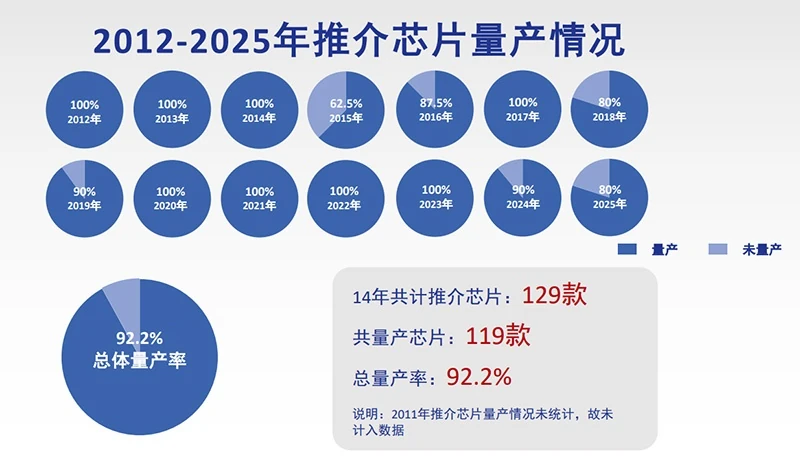
At the conference, Dai Weimin noted that the products showcased at the forum each year emphasize mass production and practical implementation, which is a key feature that distinguishes the Songshan Lake Forum from typical technology forums. Over the past few years, many domestically produced chips unveiled at the forum have entered mass production, and some companies have subsequently gone public. For the AI glasses industry, what truly warrants attention going forward is not who will be the first to release a concept product, but who can drive end-user shipments into the millions.
This year’s forum also featured a roundtable discussion titled “The Path to Industrialization of AI Glasses,” inviting representatives from across the industry chain—including Hengxuan Technology, Goertek Microelectronics, Lingban Technology, Yijing Virtual, VeriSilicon, Thunderbird Innovation, and Zudian Semiconductor—to participate in the discussion. With companies specializing in chips, end devices, displays, sensors, audio, and algorithms engaging in dialogue under one roof, the AI glasses industry is transitioning from isolated innovation to a phase of ecosystem synergy.
It is foreseeable that the future competition in the AI glasses market will not be limited to rivalry among device brands, but will instead involve a comprehensive contest across the entire chip supply chain, system design capabilities, and the application ecosystem. Only those who can be the first to resolve the trade-offs between lightweight and comfortable wearability, long battery life, on-device intelligence, and cost control will have the opportunity to truly propel AI glasses from being a “new tech product” to becoming an “everyday device.”
Source: Yfei.com Author: Li Jian

Please log in to your member account first. *



0 Comments