

By: Xihe-
On: 17 Mar 2026


| Sub-Total : | $23.30 |
| Eco Tax (-2.00) : | $4.52 |
| VAT (20%) : | $5.66 |
| Total : | $33.48 |
By: Xihe-
On: 17 Mar 2026
Source: Times Weekly Author: He Shanshan
"It's absolutely amazing! There were huge crowds at each booth, and they even had to impose limits on the number of visitors to ensure a smooth experience." On March 14th, an exhibitor at AWE (China Home Appliance and Consumer Electronics Expo) told a reporter from Time Weekly.
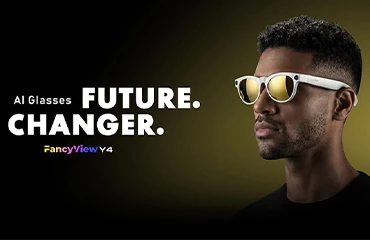
As one of the world's three major home appliance and consumer electronics exhibitions, this year's AWE adopted the "one exhibition, two zones" model for the first time. The exhibition area expanded to 13 exhibition halls covering 170,000 square meters. At the exhibition site, AI wearable devices burst onto the scene in various forms such as rings, glasses, and headphones, completely capturing the interest of the audience.
Behind this trend is the explosive growth of the industry. Take AI glasses as an example. The latest data released by Omdia (a global technology market research institution) shows that the global shipment of AI glasses will reach 8.7 million units in 2025, a significant increase of 322% compared to the previous year. Among them, the Chinese market accounts for 10.9% of the global AI glasses market, ranking second only to the US market. In addition, the global wearable device market size has reached 179.8 billion US dollars in 2024 and is expected to exceed 995.2 billion US dollars by 2034.
From basic wristbands to AI glasses and rings, AI wearable devices are rapidly evolving into "personal AI terminals", becoming the next big trend in AI hardware.
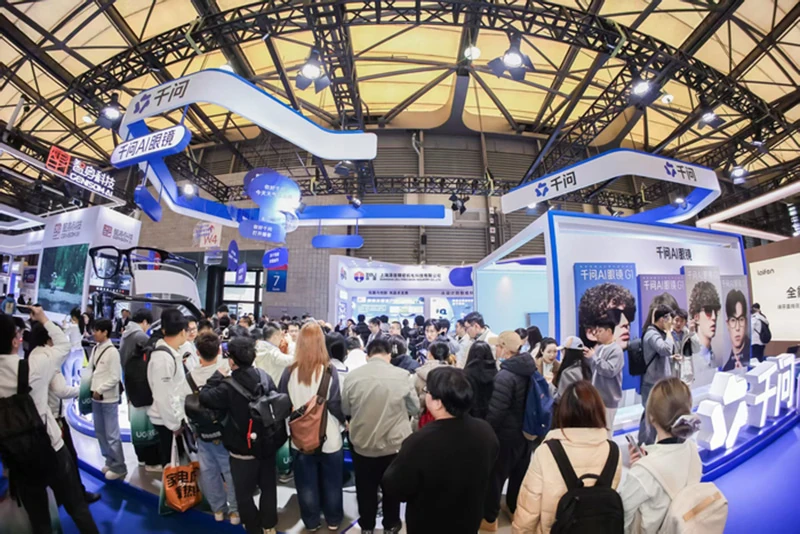
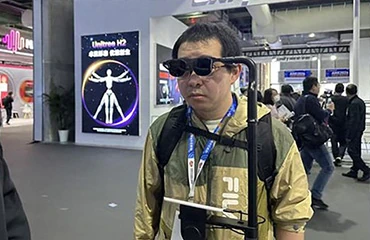
2026 AWE Exhibition Site Image Source: Provided by the Interviewee
Large companies are all showcasing their unique approaches, moving from merely recording evolution to achieving intelligent interaction.
The AI wearable trend of AWE2026 is driven by the industry's decade-long iterative upgrades.
"Over the past decade, the changes in AI wearable hardware can be observed from two aspects: form and function," said Guo Tao, an angel investor and senior artificial intelligence expert, to the Time Weekly reporter.
From a morphological perspective, early wearable smart devices were mainly hand rings and watches, with the core being health data recording, having a single function and relying on mobile phones. Now, they have expanded to multi-scenario forms such as AI rings and AI headphones, with lighter and more compact designs that better fit daily outfits, eliminating the stiffness of accessories. In terms of functionality, it has entered the era of large models + hardware. These products not only achieve a leap from simple recording to having AI interaction capabilities and providing active services, but also have more efficient data processing and better privacy protection.
Compared with previous editions of AWE, the AI wearable devices at this year's exhibition have shown three core changes: Firstly, their form has extended from the wrist to the fingertips and eyes; Secondly, in terms of technology, end-side AI can operate independently without relying on the mobile phone to complete complex instructions; Thirdly, in terms of coverage scenarios, they have expanded from health monitoring to all areas including office, consumption and life.
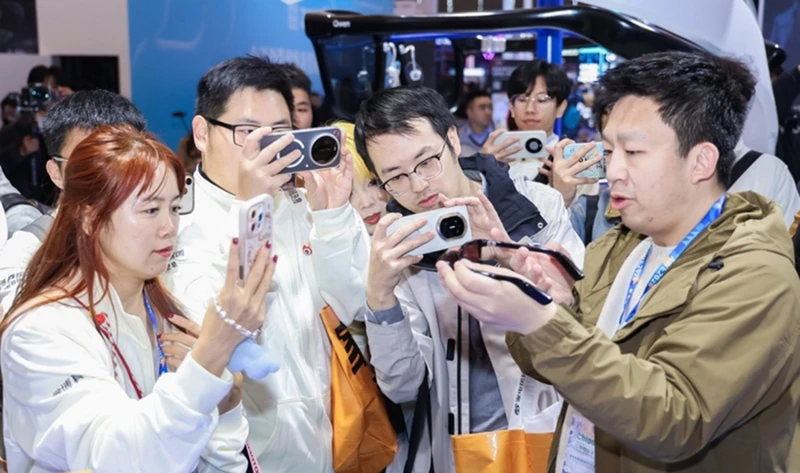
Ali's AI glasses. Source: Provided by the interviewee.
One notable change in AI wearable hardware is the shift of intelligence to cloud-based large models, reducing the requirements for the end side. The end side no longer needs to bear such heavy power consumption and large size, making it more convenient for data collection. For cloud-based large models, the efficiency is even higher. The reason why AI hardware has become more lightweight and stylish lies in this. A person related to Outai Tiantong told a reporter from Times Weekly.
The person in charge said, "The current pattern of mature markets has been firmly established, but in the long run, AI will also reshape the market landscape. AI will become even more ubiquitous."
This year's new exhibits undoubtedly mark the entry of the AI wearable industry into an explosive phase. The diverse forms of jewelry, glasses, etc. have broken the boundaries of traditional wearable devices, while the differentiated layout of AI manufacturers has made the competition in this field more dynamic. Guo Tao further analyzed that AI wearable hardware will deeply integrate with various scenarios, emphasizing more on "unobtrusive wearing" in design concepts, allowing technology to naturally blend with clothing and accessories, and further lowering the usage threshold. Additionally, different wearable hardware will work collaboratively through a unified AI system to achieve device interconnection.
This battle over "portable intelligent entry points" has just begun.

Please log in to your member account first. *



0 Comments